
According to the old song, everything in England stops at 4pm for tea! Although Jack Buchanan recorded ‘Everything Stops For Tea’ in 1935, most of us, not only in England but in the whole of the British Isles still like a cup of tea in the afternoon. It is of course a vital ingredient of an Afternoon Tea.
Table of Contents
What is an Afternoon Tea?
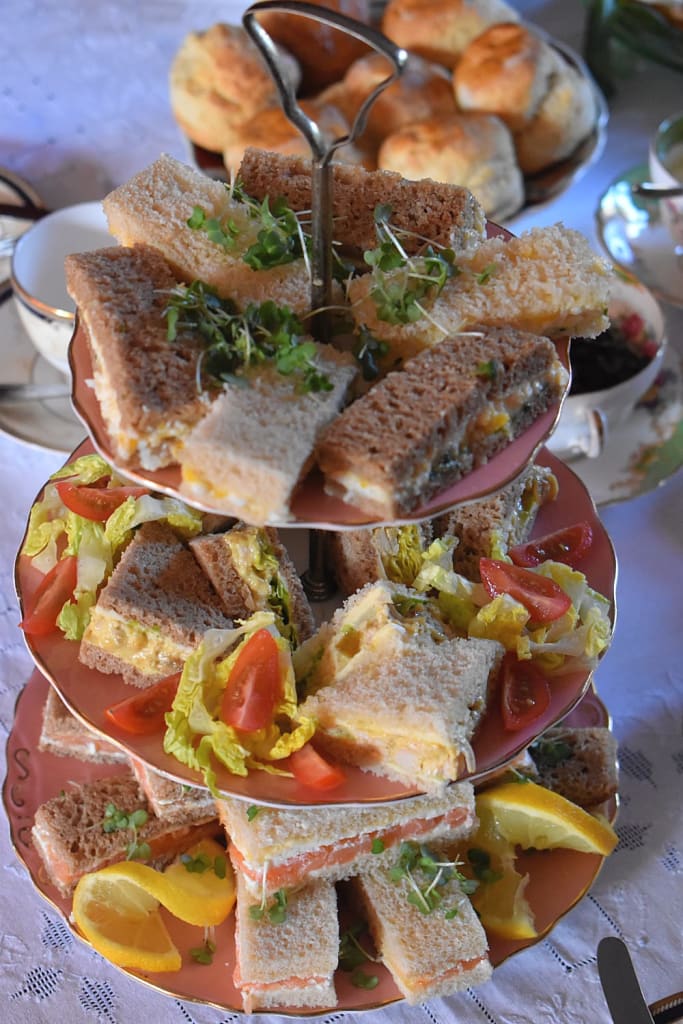
Afternoon tea is a uniquely British meal served between lunch and dinner. It can be an elaborate, elegant affair with dainty sandwiches and other savoury morsels, wafer thin bread and butter, scones and tea breads, followed by a variety of cakes and served with leaf tea made in teapot. Or at the other end of the scale, a teabag in a mug with a biscuit.
The Origins of Afternoon Tea
The invention of the elaborate, elegant Afternoon Tea is attributed to Anna, the 7th Duchess of Bedford in the mid 19th century. She found the gар between lunch at midday and dinner at 8pm left her feeling hungry by mid-afternoon. So she ordered tea and light refreshments to be served such as bread and butter and cake. She invited friends to join her and soon it became fashionable to serve afternoon tea.

Of course the elegant, elaborate teas that were served in Victorian and Edwardian days were only available to the upper classes who had servants to prepare and serve them.The custom of taking tea in the afternoon can also be attributed to the popularity of the London Tea Gardens of the 18th and early 19th century.
These were usually open for the spring and summer months and provided pleasant gardens to walk in, elegant buildings where people could dance or listen to music, bowling greens and other forms of entertainment.
They also served tea, coffee, chocolate and other drinks with light refreshments such as bread and butter and cakes. Here the classes mingled as anyone who could afford the price of a ticket was admitted.
At Ranelegh, one of the most famous of the tea gardens the admission price of two shillings and sixpence included the Elegant Regale of Tea, Coffee, and Bread and Butter.

In Victorian times tea also played a part in women’s emancipation. Tearooms such the ABC Tearooms and Lyons Corner Houses which opened in the 19th century became one of the first public places where Victorian women could eat a meal alone or with female friends without a male escort.

Although these chains finally closed their doors in the 1980s, there are still many independent tea rooms and afternoon tea is served in many hotels and restaurants. In fact in recent years there has been a resurgence in demand for afternoon tea as a celebratory meal.
Afternoon Tea in my family
When I was growing up in the late 1950s and early 1960s my brother, sister and I always had ‘Tea’ when we returned home from school. This consisted of tea (children drank tea in those days, fizzy drinks were a rare treat and fruit juice came in cans) with bread & butter and homemade cake.
We were not allowed to eat the cake until the bread and butter was all gone!! This bridged the gap between our school dinner and evening meal, thus performing the same function as the elaborate teas of the Victorian and Edwardian upper classes.
In my family, tea parties are often used to celebrate special occasions. We have a tradition of afternoon tea on Mothering Sunday (the UK’s and Ireland Mother’s Day).
Last year was the first year my grandchildren prepared a special tea for their mother and myself unaided. It was a lovely afternoon tea and I am sure this year’s will be just as delicious.

How to make and serve your own Afternoon Tea at home
Serving afternoon tea at home as a celebration meal is not difficult. Don’t worry if you are not a baker, you can buy good quality baked goods from most supermarkets and then you only need to make the sandwiches – the trick is in the presentation!
Here are some hints and tips on serving an afternoon tea to rival the Duchess of Bedford’s.
Presentation
This is most important. No matter how delicious your sandwiches, cakes etc. are, if they are not beautifully presented ie: on pretty serving plates and/or cake stands decorated with herbs, salad leaves, edible flowers etc. you will have wasted your time.
Pretty cups, saucers and plates are also essential. If you don’t have these and cannot borrow them, charity shops are a good economical source of vintage china. Your china does not have to match – mix and match can look charming.
You will need at least one teapot, but preferably 2 or 3 so you can offer a choice of tea. You may also wish to serve coffee.
You will need glasses if you are serving soft drinks. At a very special celebratory tea you may like to serve champagne or other fizz – and will need glasses for this.
A vintage tablecloth would be nice (also available in charity shops) but a crisply ironed sheet makes a good substitute.
Seating
A small party can be seated around a dining table – a larger party can be served buffet style.
People seated at a table will be able to spread cream and jam on scones themselves and will be able to eat cream cakes with a cake fork. If you are serving buffet style make sure you have prepared everything so it can be easily eaten with the fingers and items are only one or two mouthfuls.
Tea
Please, please, please use leaf tea, not teabags. If you haven’t got a strainer don’t worry – the few leaves that escape the teapot will sink to the bottom of the cups. In my younger days there was always someone who would tell your fortune from the tea leaves left in your cup.
If you would like some advice on making tea – or golden rules as he describes them, check out George Orwell’s essay ‘A Nice Cup Of Tea’ .
Food
a) Sandwiches
These should be made from thinly sliced bread with the crusts removed and each round sliced into four triangles or three fingers. If you are slicing your own bread, use day old bread. You cannot slice fresh bread into the thin dainty slices you need.
They can be made some hours in advance as long as you don’t include tomatoes or cucumber in your fillings, as these will soon make the bread soggy.
Make up your sandwiches and leave them uncut with the crusts on and store in the fridge, wrapped in cling film.
Allow one round per head and make at least three different fillings. Try to use different types of bread. If you have guests with special dietary requirements you may need more variety.
b) Other Savoury items
You can offer other savoury items such as sausage rolls and cheese scones, just make sure they are as dainty your sandwiches.
c) Scones and Tea breads
Scones are traditionally served with afternoon tea – serve your freshly baked scones with butter or clotted cream and jam. Do make them small – I use a 2 inch / 5cm cutter.

If you don’t want to bake your own scones you probably will have difficulty buying commercially made ones as these tend to be quite large. You can however substitute thinly sliced fruit breads such as fruit loaves or just thinly sliced bread and butter served with a homemade or good quality shop bought jam.
d) Cakes
At least three different varieties of small cakes – more for a larger party or if you have guests with special dietary requirements. One or more large cakes according to the size of the party. If it is a birthday party the birthday cake can be one of these.
My Afternoon Tea
I made a special afternoon tea last weekend (see the photos in this post) for my family which included :
- Sandwiches (Egg and Cress, Coronation Chicken, Smoked Salmon and Cream Cheese and Mini open sandwiches with pesto, mozzarella Cheese, tomato and basil)
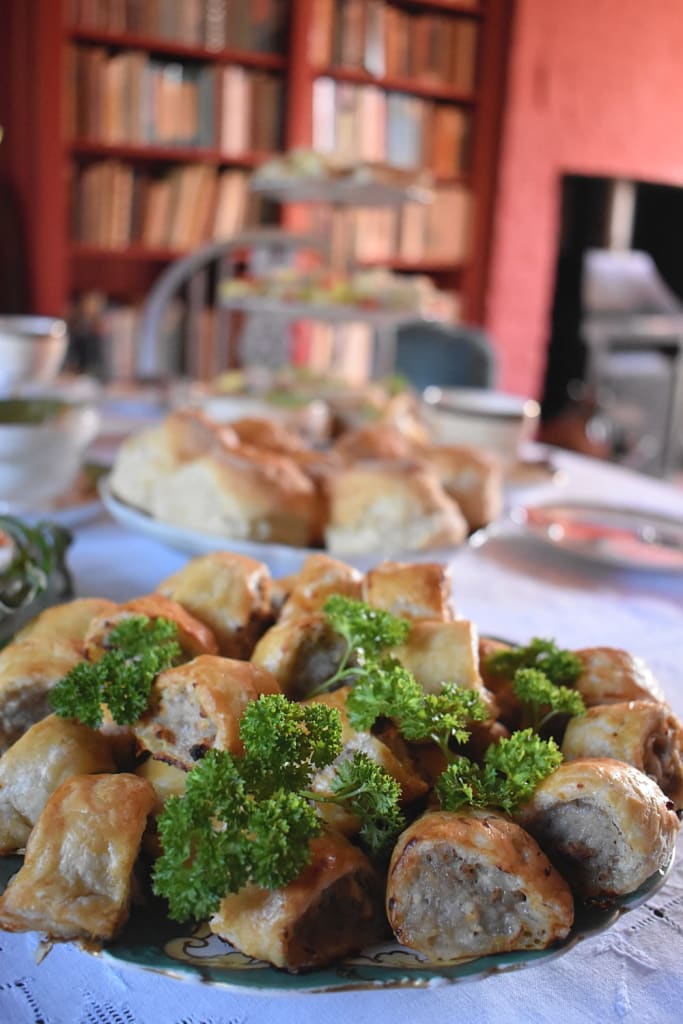
- Mini-Sausage Rolls
- Plain Scones (I served mine with clotted cream and damson jam)
- Mini Pavlovas
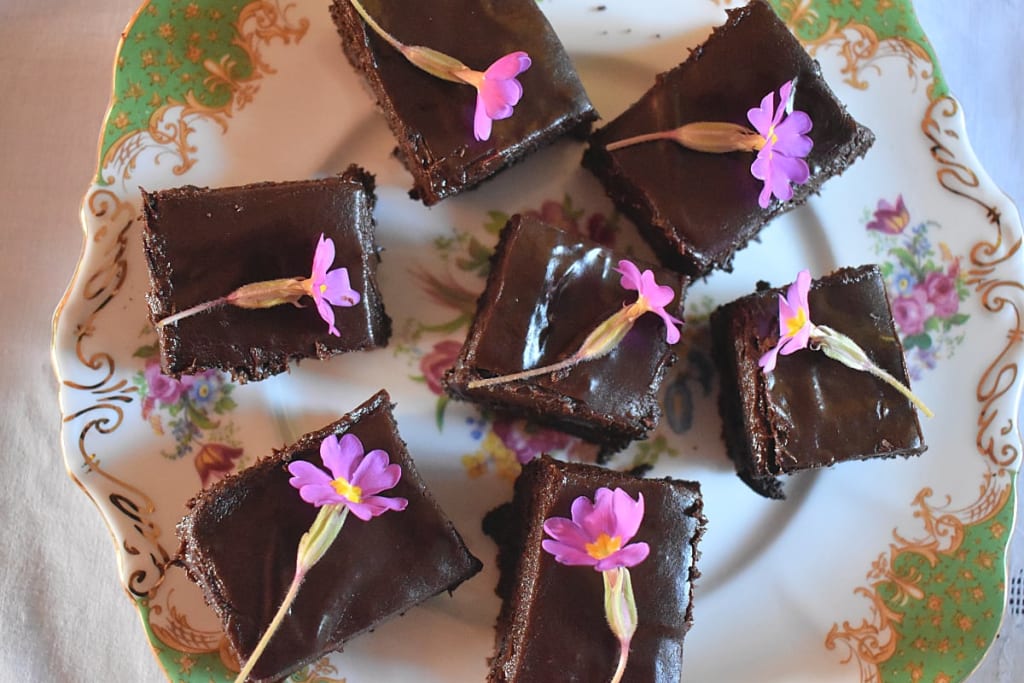
- Chocolate Brownies
- Eccles Cakes
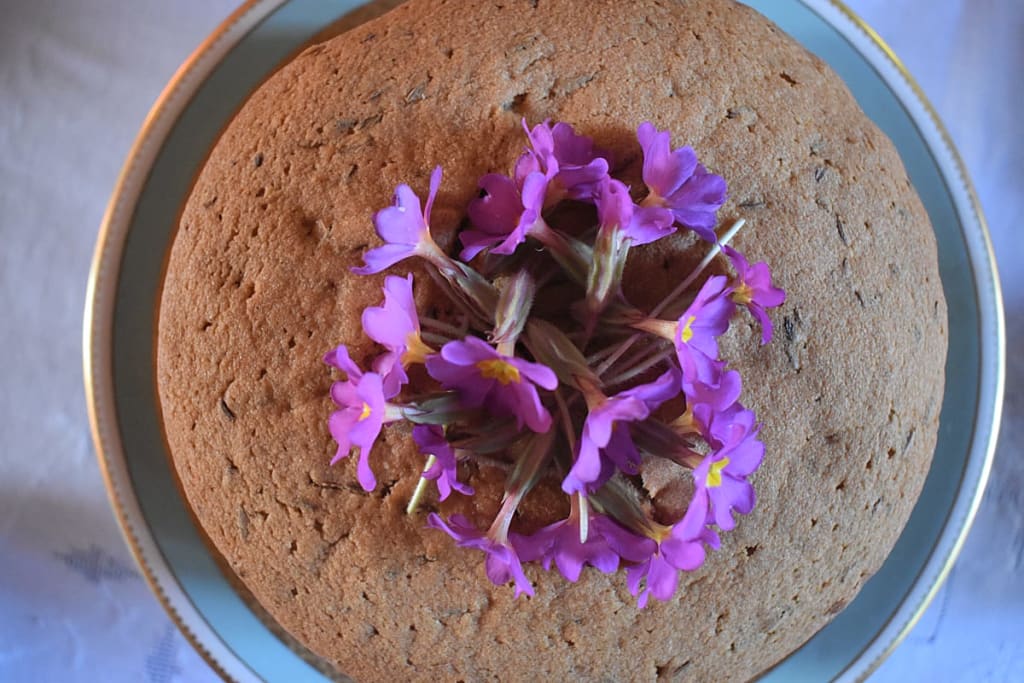
- Old Fashioned Caraway Seed Cake
You will find many recipes on the blog suitable for serving for afternoon tea but if you don’t want to bake, Marks & Spencer is excellent for cakes and as long as everything is presented elegantly on pretty china no one will ever know.
If you do host an afternoon tea, perhaps on Mothering Sunday or at Easter please do add a comment below – I would love to hear from you.
One Last Word
Afternoon Tea for One

Remember that Afternoon Tea for one is very pleasurable. One day last week I had a very busy morning but had a free afternoon. I got out my English Paper Piecing (a method of patchwork where fabric is wrapped around fabric shapes made of thin paper cardboard or heavy paper) and switched on Classic FM on my radio. I then laid myself a tray using pretty china with a teapot for one.
I had nothing elaborate, just fruit loaf and butter with Earl Grey tea, but I really enjoyed my Afternoon Tea. It was so much better than a teabag in a mug with a biscuit.
After all as Oscar Wilde said:
‘Tea is the the only simple pleasure left to us’
Until next time…
Happy baking!
Tanya


